
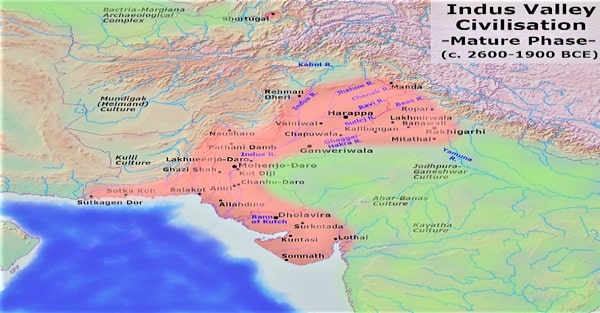
The Indus Valley Civilization was a Bronze Age civilization, developing from around 3300 BC. C. until 1300 a. C. along the valley of the Indus River, in Afghanistan, Pakistan, and northwestern India. It encompassed about a hundred settlements and two major cities: Harappa and Mohenjo-Daro, both in Pakistan.
Altogether, it comprised the largest area of all ancient civilizations, more than a million square kilometers, and spanned several periods, its greatest splendor being among the 2600 and 1900 A. C. Like the civilizations of Mesopotamia and Egypt, it depended on its river. Like the Nile, the Indus overflowed every year, flooding vast areas and depositing fertile sediments.
This immense agricultural potential was the basis on which urbanism around the Indus River developed. With the prehistoric cultures of the Indus Valley, the first chapter of the history of India is being prepared. It is a long prehistoric period, proven by lithic testimonies.
On the other hand, prehistoric remains can be found up to the 1st millennium BC. C., that is, until a time when the peninsula had already entered history. Strictly speaking, the Indus cultures belong to prehistory as they have only left archaeological remains without literary documents, but to appreciate Indian history it is necessary to take these pre-Aryan urban cultures into consideration.
Archaeologists say the Indus Valley civilization is the most extensive ancient civilization discovered after the Mesopotamian and Egyptian civilization sites. In 1980 the Indus Valley civilization was designated a world heritage site by UNESCO.
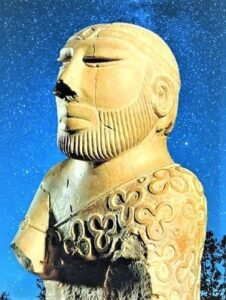
Indus Valley Civilization Facts
- Period: Bronze Age South Asia
- Dates: c. 3300 – c. 1300 BCE
- Preceded by: Mehrgarh
- Followed by:
Painted Grey Ware culture
Cemetery H culture
Discovery and Exploration
The sources for the Harappa culture are, unlike those for the other two advanced cultures in Egypt and Mesopotamia, very sparse. Only about ten percent of their settlements have been excavated. Its writing has not yet been deciphered, nor has it disappeared from around 1900 BC. Clarified.
Even Sanskrit texts from the 1st millennium BC do not directly mention this early culture. It is also not certain which language people spoke at the time or what they called themselves.
Although the ruins at Harappa had been known for some time and were first described by Charles Masson in 1844 in his book Narrative of Various Journeys in Balochistan, Afghanistan and The Panjab as “a brick-built, destroyed fortification”, its significance was not recognized until much later been.
In 1857 the British used in the construction of the railway from Multan to Lahore the route burnt bricks, which they found on the nearby ruins in Harappa for attachment. The location in Harappa is therefore quite poor compared to Mohenjo-daro.
Mohenjo-daro had also been known for a long time, but here they were more interested in the remains of a later Buddhist monastery from the 2nd century AD, which was built on the ruins.
In 1912 J. Fleet found seals with unknown characters in what was then British India, which aroused the interest of the scientific public in Europe. Subsequently, excavations were carried out in 1921/22 in Harappa and Mohenjo-Daro under the direction of John Marshall, the then director of the British Antiquities Service.
The similarity of the two excavated cities quickly made it clear that a previously unknown high culture was here had been discovered. More than 10 hectares had been excavated by the city of Mohenjo-Daro by 1931, but after that only smaller excavations took place, including in 1950 by the British Mortimer Wheeler.
In 1935/36 another Indus culture site was excavated with Chanhu-daro. Since the partition of British India in 1947, the settlement area of the Harappa culture has been divided between Pakistan and India. In Pakistan, the Americans, French, British, and Germans carried out further research work together with Pakistani archaeologists, while the Indian Antiquities Service continued the work in India.
In addition to the archaeologists already mentioned, the British had and still have a great influence on Indus research Aurel Stein, the Indian Nani Gopal Majumdar, and the German Michael Jansen.
Economy
The spreading area of the Indus Valley civilization extends from the lapis mining region in the mountainous northern part of present-day Afghanistan to the Arabian Sea coasts in the south, and from the highland pastures of Balochistan in the west to the mining deserts of Cholistan and Thar to the east.
The heart of the territory was represented by the river valleys of the Indo and the ancient Ghaggar-Hakra, now disappeared. The economy was mainly based on agriculture and livestock, as well as on the exchange of handicrafts even over great distances.
The term Meluhha which appears in some Sumerian documents to indicate an important trading partner has been interpreted as the name of the Indus Civilization.
Agriculture
The alluvial plains, irrigated by melting snow in the mountains and seasonal monsoon rains, allowed the development of prosperous agriculture, supplemented by fishing and hunting and forest resources, which ensured the subsistence of the urban population.
Little information has reached us about the nature of the agricultural system: however, some hypotheses can be formulated. The agricultural system had to be highly productive, to ensure the subsistence of a large urban population not primarily employed in agriculture itself.
Compared to the ancient Harappa culture there must have been some important technological innovations, probably including the use of the plow, but there does not seem to be any traces of an irrigation and water regulation system (which however may not have been preserved due to the frequent disastrous floods of the rivers).
It would therefore seem that the hypothesis of “hydraulic despotism”, according to which the development of an urban civilization could only take place through the production of a considerable agricultural surplus, allowed by ‘introduction of irrigation systems, and these in turn inevitably imply the presence of a centralized and despotic power, which has the ability to employ the labor force of thousands of people.
As already mentioned, however, there is no trace of royal power in the cities. Furthermore, the traditional cultivation system still used in Asia allows the production of a significant agricultural surplus by means of rice cultivation terraced, built with the work of several generations without involving forms of forced labor or slavery: similar modalities could have allowed the urban development of the Indus Valley civilization.
Industry
They adorned their bodies with rich ornaments of silver, gold, ivory, and precious stones. They knew copper, tin, and lead. They used copper for weapons, instruments and utensils and also bronze tools (even axes). For domestic purposes they made clay utensils in a great variety of shapes.