
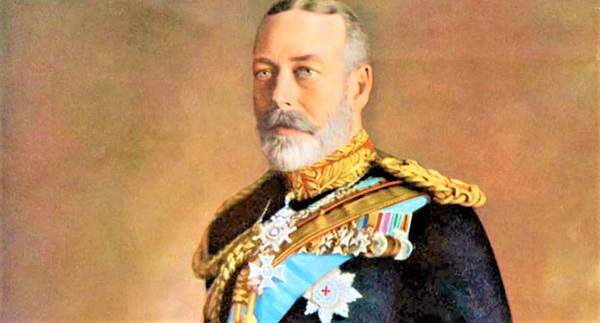
George V was born George Frederick Ernest Albert on June 3, 1865, and died January 20, 1936, was king of the United Kingdom and the dominions (Canada, Australia, New Zealand, South Africa, Ireland), and emperor of India of May 6, 1910, to his death.
George was the grandson of Queen Victoria and Prince Albert and the first cousin of Tsar Nicholas II and the German Emperor William II. From 1877 to 1891, he served in the Royal Navy and reached the rank of Commander.
When Queen Victoria died in 1901, George’s father became king under the name of Edward VII and George was made Prince of Wales. On the death of his father in 1910, he succeeded him as king-emperor of the British Empire under the name of George V. He was the only Emperor of India to attend his darbar in Delhi.
Following the First World War, the British Empire reached its maximum extent. In 1917, he became the first monarch of the house of Windsor after having renamed the house of Saxe-Coburg and Gotha because of anti-German feelings in the United Kingdom.
His reign saw the rise of socialism, communism, fascism, Irish republicanism, and Indian independence which radically changed the political landscape. The Parliament Act of 1911 establishes the supremacy of the House of Commons elected by the people over the House of Lords whose members are appointed by the sovereign.
In 1924 George V appointed the first British Labor Prime Minister Ramsay MacDonald, and in 1931 the Statute of Westminster removed dominion rights from the Commonwealth of Nations. Victim of health problems in the last years of his reign, he died on January 20, 1936, and his eldest son Edward succeeded him under the name of Edward VIII.
The Early Life of George V
Prince George V is born on June 3, 1865, at the Royal Residence of Marlborough House in London. His father is the Prince of Wales, future Edward VII, eldest son of Queen Victoria and Prince Albert of Saxe-Coburg and Gotha.
Her mother is Princess of Wales Alexandra of Denmark, eldest daughter of King Christian IX. As the Prince of Wales’ son, George receives the predicate: His Royal Highness Prince George of Wales. He was baptized in the chapel of St. George of Windsor Castle on July 7, 1865, by the Archbishop of Canterbury, Charles Longley.
As the cadet of the Prince of Wales, George is unlikely to rise to the throne. His older brother, Albert Victor, is second in succession after his father. The two brothers are only 17 months apart and they are raised together; in 1871 John Neale Dalton was chosen to be their tutor.
Neither Albert Victor nor George excelled intellectually. Their father considers the navy to be the best possible training for a boy 5 and the two brothers join the Royal Navy in September 1877and are deployed on the training vessel HMS Prince of Wales stationed at Dartmouth.
From 1879, Albert Victor and George V served for three years on HMS Bacchante accompanied by Dalton. They tour the colonies of the British Empire in the Caribbean, South Africa, and Australia and go to the United States, South America, the Mediterranean, Egypt, and Asia.
In Japan, George asked a local tattoo artist to draw a blue and red dragon on his arm. Dalton writes about The Cruise of HMS Bacchante. between Melbourne and Sydney, Dalton notes the vision of the ghost ship the Flying Dutchman.
When they returned to the United Kingdom, Queen Victoria complained that her grandchildren did not speak French or German and the two brothers were sent six months to Lausanne in Switzerland but were unable to learn another language.
After Lausanne, Albert Victor, and George are separated; Albert Victor entered the Trinity College of Cambridge University and George remains in the Royal Navy. He made many trips around the world and visited many regions of the British Empire until his last command in 1891-1892 as a captain. After that, his rank in the Royal Navy was largely honorary.
George V Marriage with Mary of Teck
As a young man destined to serve in the navy, Prince George V remained for several years under the command of his uncle, Prince Alfred of Edinburgh who was stationed in Malta. On the island, he meets and falls in love with the daughter of his uncle, his cousin Marie of Edinburgh.
Her grandmother, father, and uncle approved the union, but their mothers, the Princess of Wales and the Duchess of Edinburgh opposed it. The Princess of Wales thinks that the family is too pro-German and the Duchess of Edinburgh does not like England and does not want a marriage between first cousins (practice prohibited by the Russian Orthodox Church). Pushed by his mother,
Ferdinand, the heir to the Romanian throne, in 1893. In November 1891, George’s older brother, Albert Victor got engaged with his first cousin, Princess Victoria Mary of Teck. Her father, François de Teck, belongs to a younger and morganatic branch of the House of Württemberg.
Her mother, Princess Mary Adelaide of Cambridge, is the granddaughter in the male line of King George III and the first cousin of Queen Victoria. Six weeks after the engagement, Albert Victor died of pneumonia; George thus passes in the second position in the order of succession to the British throne and becoming a direct heir, it becomes likely that he succeeds his father.
George V has just recovered from a serious illness and stayed in bed for six weeks due to typhoid fever. Queen Victoria continues to consider Mary of Teck as a possible partner for her grandson George and they get closer during the mourning period.
A year after the death of Albert Victor, George V and Mary become engaged and they married on July 6, 1893in the royal chapel of Saint James palace in London. Although the marriage has been arranged, the two spouses develop a deep affection for each other.
George is, by his own admission, unable to easily express his feelings orally, but they frequently exchange letters and notes of affection.
Duke of York
The death of his older brother put an end to George’s military career, being second in succession to his father. George is made Duke of York, Earl of Inverness and Baron Killarney by Queen Victoria May 24, 1892, and receives lessons in constitutional history with JR Tanner. After her marriage to George, Mary received the title of Royal Highness, Duchess of York.
The Duke and Duchess of York reside primarily at York Cottage, a relatively small residence near Sandringham House where their lifestyle is more like that of an affluent middle-class family than that of the aristocracy.
George prefers a simple and peaceful life as opposed to his father’s hectic social life. His official biographer, Harold Nicolson, commented negatively on this period: He may have been a perfect young cadet and a wise old king, but when he was Duke of York… he did nothing but hunt and stick stamps.
George is a famous philatelist, which Nicolson despises but it played a large role in the creation of the Royal Philatelic Collection which became the most complete collection of stamps in the United Kingdom and the Commonwealth.
George and Mary have five sons and one daughter. Randolph Churchill claims that George is a strict father whose children are afraid and reports George’s words to Edward Stanley, my father was afraid of his mother, I was afraid of my father and I will make sure that my children are afraid of me.
Since there is no direct source of this confidence, it is likely that George’s education was similar to that of most parents at the time.
Prince of Wales
In Melbourne, Australia, George V opened the first parliamentary session of the newly created Commonwealth of Australia on May 9, 1901. On his return, his father gave him the traditional title of heir to the throne, on which George was appointed Prince of Wales on November 9, 1901.