
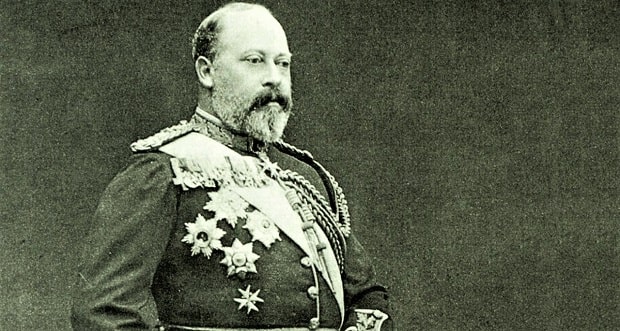
Edward VII (born Albert Edward on November 9, 1841, in London at Buckingham Palace and died on May 6, 1910, in the same place), is the king of the United Kingdom and the dominions (Canada, Australia, New Zealand, Newfoundland) as well as emperor of India from January 22, 1901, until his death.
Son of Queen Victoria, Albert-Edward remained the heir to the British Crown and carried the title of Prince of Wales for almost 60 years. During his mother’s long reign, he was largely sidelined from political issues and personified the wealthy British aristocratic elite.
The Edwardian era coincided with the beginning of the 20th century and underwent major technological and social changes. Edward VII played an important role in the modernization of the Home Fleet, the reform of military medical services, and the reorganization of the British Army after the Second Boer War
He developed good relations between the United Kingdom and the other European countries, in particular France, and for that received the popular nickname of Peacemaker.
Quick Facts: Edward VII
- Born: 9 November 1841, Buckingham Palace, London, United Kingdom
- Also known As: Albert Edward
- Known For: The king of the United Kingdom and the dominions
- Successor: George V
- Predecessor: Queen Victoria
- Reign: 22 January 1901 – 6 May 1910
- Coronation: 9 August 1902
- Parents: Father – Prince Albert of Saxe-Coburg and Gotha, Mother – Queen Victoria of the United Kingdom
- House: Saxe-Coburg and Gotha
- Spouse: Alexandra of Denmark (m. 1863)
- Children: George V (1841–1910), Prince Albert Victor (1864–1892), Maud of Wales (1869–1938), Princess Victoria (1868–1935), Louise, Princess Royal (1867–1931), Alexander John
The Early Life of Edward VII
Prince Albert Edward was born on November 9, 1841, the eldest son of the ruling British Queen Victoria and her Prince Consort Albert of Saxe-Coburg and Gotha in London’s Buckingham Palace. He was awarded the title of Prince of Wales four weeks after his birth.
Victoria and Albert were determined to give Bertie, as he was called in the closer family, an education that would make him an exemplary constitutional monarch. His extremely strict father ordered private tutors and educators and handed them over to the seven-year-old prince, who was however inconsistent and did not prove to be a model student.
From summer 1859 he began to study; initially at Edinburgh University, where he was under the supervision of Professor Lyon Playfair. He then became a student at the venerable University of Oxford and moved to Cambridge at Trinity College in 1861, where he worked in history from the renowned professor Charles Kingsley was taught.
In the meantime, he assumed the first official duties for the royal family as heir to the throne and traveled to North America in 1860. A British heir to the throne visited Canada and the United States for the first time. Edward showed great diplomatic skills and the visit was celebrated as a foreign policy success.
During his studies, Edward shone less with performance than with his excessive lifestyle. The prince was a dandy with preferences for gambling, alcohol, and young actresses, whose love adventures remained no secret.
The result was that his already seriously ill father came to Cambridge in December 1861 to speak to Edward and to reprimand him. Prince consort Albert died two weeks later. Queen Victoria never got over the loss of her beloved husband and made “Bertie” responsible for his early death.
Marriage and Children of Edward VII
Queen Victoria was a dynastic thinking monarch and was concerned about the succession to the throne since Eduard was still single. She also wanted to steer her son’s life in an orderly fashion through marriage. With the help of her eldest daughter Princess Victoria, she arranged to marry Princess Alexandra of Denmark, the daughter of the future King Christian IX.
Edward VII and Alexandra married on March 10, 1863 in St George’s Chapel at Windsor Castle and Alexandra became Princess of Wales. The young couple moved into the city villa Marlborough House in London and a stately country house with Sandringham House in the county of Norfolk. A total of six children emerged from the connection:
- Albert Victor, Duke of Clarence and Avondale (born on January 8, 1864; Died on January 14, 1892)
- George, Duke of York, Prince of Wales (born on June 3, 1865, Died on January 20, 1936), as George V British King ⚭ Maria von Teck
- Louise, Princess Royal (born on February 20, 1867; Died on January 4, 1931) – Alexander Duff, 1st Duke of Fife
- Princess Victoria (born on July 6, 1868, Died on December 3, 1935)
- Maud (born on November 26, 1869, Died on November 20, 1938) – Haakon VII of Norway
- Alexander John (born on April 6, 1871, Died on April 7, 1871)
Prince of Wales
After her husband’s early death, Queen Victoria withdrew as far as possible from the public and lived a strict widowhood. For this reason, the crown prince had increased public appearances, which his mother avoided.
His cosmopolitan manner and diplomatic skills had a positive impact, especially when receiving foreign state guests. However, his mother did not allow him to play an active role in governance. Eduard was Prince of Wales for a total of 59 years and was considered an “heir to the throne.”