
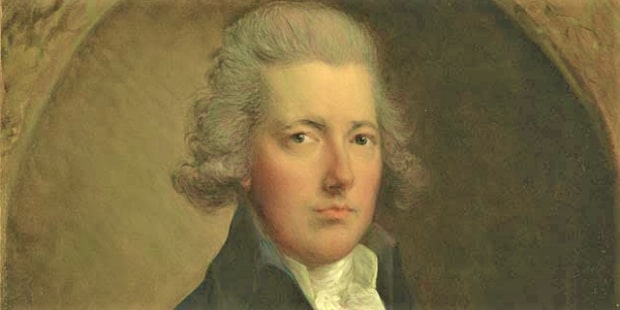
William Pitt the Younger (Born on May 28, 1759, in Hayes, Bromley, United Kingdom – Died on January 23, 1806, in Putney, Surrey, England) Is a statesman British in the late 18th and beginning of the 19th century. He became the youngest British Prime Minister when he was elected in 1783 at the age of 24 (although the term Prime Minister was not yet used).
He left the post in 1801 but became Prime Minister from 1804 until he died in 1806. He also served as Chancellor of the Exchequer throughout his tenure as Prime Minister. He is called William Pitt the Younger to be distinguished from his father, William Pitt the Elder, who was also Prime Minister of Great Britain.
In 1782, he joined the government of William Petty FitzMaurice as Chancellor of the Exchequer. Pitt’s first term in the reign of George III of the United Kingdom was dominated by important events in Europe including the French Revolution and the Napoleonic Wars.
Pitt, although often referred to as a Tory, considered himself an “independent Whig” and generally opposed the development of a partisan political system.
Quick Facts: William Pitt
- Born: 28 May 1759, Hayes, Bromley, United Kingdom
- Known For: The Youngest British Prime Minister
- Also known as: William Pitt the Younger
- Parents: (Father- William Pitt, 1st Earl of Chatham) (Mother- Hester Grenville)
- Nationality: British
- Political party: Tory
- Died: 23 January 1806 (aged 46) Putney, Surrey, England
- Quotes: “Necessity is the plea for every infringement of human freedom. It is the argument of tyrants; it is the creed of slaves.”
The Early Life of William Pitt
The Honorable William Pitt, the second son of William Pitt the Elder, was born in Hayes in the district of Bromley in London. His mother, Hester Grenville, was the sister of former Prime Minister George Grenville. According to biographer John Ehrman, Pitt inherited the dynamism and genius of his father and the determined and methodical nature of the Grenville line.
An intelligent but fragile child, he was educated at home by the Reverend Edward Wilson and quickly became an expert in Latin and Greek. In 1773, then aged 14, he entered Pembroke College in Cambridge where he studied political philosophy, ancient literature, mathematics, trigonometry, chemistry, and history.
In Cambridge, Pitt to tutor George Pretyman who became a close friend. Pitt later appointed him Bishop of Lincoln and later of Winchester and he made good use of his advice throughout his political career 5. He became friends with the young William Wilberforce who would become a faithful friend and a political ally in parliament.
Pitt tended to socialize only with other students and those he already knew and rarely ventured out of college. Yet he was described as charming and friendly. According to Wilberforce, Pitt had an exceptionally keen mind and a sense of humor endearing: “No man … did not undertake more freely and happily in this playful joke that flatters everyone without hurting any “.
In 1776, Pitt, handicapped by his fragile health, used a little-used privilege reserved for the sons of nobles and chose to graduate without having to pass an exam. Pitt’s father, who had been raised to the rank of Earl of Chatham, died in 1779.
Not being an elder son, Pitt received only a small share of the paternal inheritance. He received legal education at Lincoln’s Inn and was called to the bar in the summer of 1780.
Political Career of William Pitt
During the general election of 1780, Pitt fought to get a seat for the University of Cambridge but lost it. However, he was intending to enter Parliament, with the help of a university colleague of his, Charles Manners, Duke of Rutland, secured the support of Sir James Lowther.
Lowther controlled Appleby’s small constituency; an additional election in this constituency brought Pitt into the House of Commons in January 1781. In Parliament, the young Pitt put aside his shyness and his reserved nature, which characterized him during the university period, becoming that famous politician and a speaker that history has immortalized.
Pitt initially aligned himself with influential Whigs such as Charles James Fox and Edmund Burke. With these, he denounced the continuation of the war in the Americas and proposed that the Prime Minister, Lord North, negotiate peace with the rebel American colonies. Besides,
William Pitt supported a bill aimed at reforming Parliament, including the proposal to contain electoral corruption. After the fall of Lord North ‘s government in 1782, Whig Charles Watson-Wentworth, Marquis of Rockingham was appointed prime minister.
Pitt was offered the secondary post of Deputy Treasurer of Ireland; however, demonstrating extraordinary self-confidence, he refused this assignment, which he deemed too subordinate. Just three months later, when Lord Rockingham died, William Petty, Earl of Shelburne, another Whig, came to power.
Many Whig leaders who had taken part in the Rockingham ministry, including Charles James Fox, now refused to serve under the new Prime Minister. Pitt, on the other hand, was not at all reluctant to join the Shelbourne government and was thus appointed Chancellor of the Exchequer.
Fox, who became Pitt’s lifelong political opponent, later formed a coalition with Lord North, with whom he collaborated to defeat the Shelbourne administration. When Lord Shelbourne resigned in 1783, King George III, who despised Fox, offered Pitt the post of Prime Minister.
Pitt, however, with common sense refused, realizing that he would be unable to secure the support of the House of Commons. The Fox-North coalition seized power under the nominal leadership of William Henry Cavendish-Bentinck, Duke of Portland.
Pitt, who had been fired from his post as Chancellor of the Exchequer, joined the opposition. He raised the issue of parliamentary reforms intending to unhinge the Fox-North coalition which brought together both the advocates and the detractors of the reform.
Pitt did not initially advocate an extension of the right to vote but sought to remedy the corruption of constituencies. However, his intention failed, however many reformers in Parliament recognized him as their leader, instead of Charles James Fox.
William Pitt American Revolution
The defeat and loss of the 13 colonies were a shock to Britain. The war had exposed the state’s financial and military limits when it faced powerful adversaries in distant territories without allies. The defeat aggravated the dissensions and the antagonism towards the ministers of the King.
In parliament, the main concern went from the fear of an absolute monarchy to the problems of representation, parliamentary reform, and the reduction of government spending. The reformers wanted to destroy what they saw as widespread institutional corruption. The result was a crisis that lasted from 1776 to 1783.
While the peace of 1783 left France financially drained, the British economy benefited from the resumption of trade with America. Thanks to the king’s ability to reject Fox’s demands and renewed confidence in the system spawned by Pitt’s leadership.
Historians conclude that the loss of the American colonies enabled the United Kingdom to face the French Revolution with greater unity.
Become Prime Minister of UK
Having secured the government, Pitt was able to implement his plans. His major bill as prime minister was the India Act (1784), which reorganized the East India Company and aimed to crackdown on corruption. The India Act created a new Control Cabinet to oversee the affairs of the India Company.