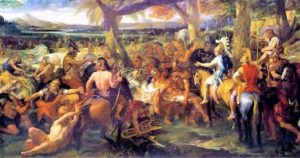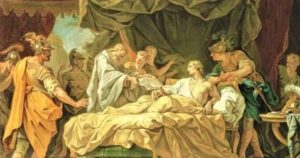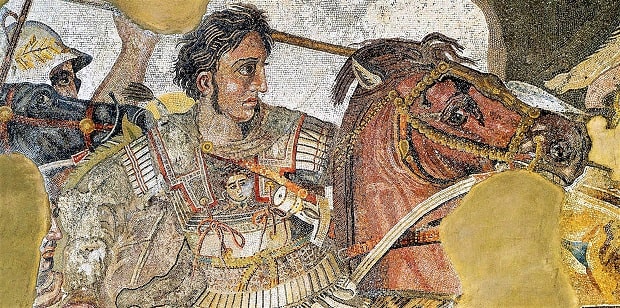
Alexander the Great is also known as Alexander III of Macedonia was born on 20 July 356 BC in Pella. Alexander extended the borders of the empire, which his father Philip II had built from the previously rather insignificant small state of Macedonia and several Greek polises, through the so-called Alexander Train and the conquest of the Achaemenid Empire to the Indian subcontinent.
After his invasion of Egypt, he was greeted there as Pharaoh. Not least because of his great military success, Alexander’s life became a popular subject in literature and art, while Alexander’s assessment in modern research, as in ancient times, was ambiguous.
When he came to power, the age of Hellenism began, in which Greek culture spread over large parts of the then known world. The cultural influences of the Hellenization survived the political collapse of the Alexander empire and its successor states and continued to have an effect in Rome and Byzantium for centuries.
Early Life of Alexander the Great
Alexander the Great was born in Pella, the capital of Macedonia, north of present-day Greece, probably on July 20, 356 BC. C. Son of Philip II, king of Macedonia and Queen Olympia, descended from a noble family in the kingdom of Epirus (present-day Albania).
Many details of his biography, especially from his childhood, were soon legendary decorated or invented. A good 400 years later, Plutarch reports that Alexander could no doubt trace his paternal lineage back to Heracles and Karanos, the first king of the Macedonians, which implicitly emphasizes Alexander’s descent from Zeus, the father of the gods.
Alexandre was a student of the best masters of the time. At the age of 13, he taught the Greek philosopher Aristotle. He studied rhetoric, politics, physical and natural sciences, medicine, philosophy, and geography.
It gave him a better understanding of Greek ideals and inspired him with admiration and love for the Greek spirit and culture. It was no coincidence that Aristotle always showed respect and gratitude. He said that he owed his father “live” and his teacher “lived well”. However, Alexander had Achilles as his role model in life and work, whom he considered to be a distant ancestor of his mother’s generation.
On the other hand, his tenure alongside Philip’s father generously offered him enormous courses in politics and strategy, as they were together in all the great events. This helped him gain political and military maturity at an early age.
It is noteworthy that as a replacement for his father who was in a campaign, he stifled the revolution of the Thracian tribe of Maids, while at the age of 18, in the Battle of Chaeronea, he was the commander of a military corps.
King of Macedonia – Alexander the Great
Alexander the Great stood out for his intelligence and for his ease with horse taming, in such a way that in a few hours he dominated the “Bucephalus”, which would become his inseparable mount. The art of war he had learned from his father, Felipe II, an experienced and courageous military man.
When its father was assassinated in 336 a. C., Alexander became king of the Macedonians, assuming two high positions: the head of the “League of Corinth” (union of several Greek communities) and commander of the best-prepared army of the time. For his achievements, he became known as Alexander the Great.
Pacification of Greece
Alexander III ascended the throne at the age of twenty, and the Macedonian Expansion was his main objective. He did not hesitate to liquidate everyone who plotted against his crown.
Some Greek cities had rebelled and were trying to break the Corinthian League. Thebes was the center of the revolt, he had even proclaimed the independence of Greece. The war was declared and Thebes was devastated. Only the playwright Pindaro’s house was spared, as proof of Alexandre’s respect for the arts.
The campaign in Persia
The decision for the great campaign was made and so in the spring of 334 BC Alexander, with 50,000 infantry and 6,000 cavalries on his side, set out for the great operation. A business that went down in history.
He arrived in Thrace and then in the Hellespont, where his fleet was waiting for him, consisting of 120 warships and many other auxiliary ships. He then passed through Troy, visiting the tomb of Achilles, making the appropriate sacrifices.
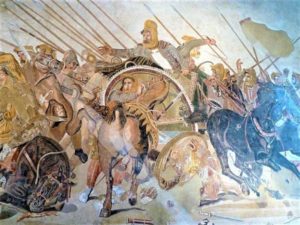
The cities opened their gates, one by one, to receive him. The first battle was fought on the banks of the Granicus River, where on May 22, 334 BC. Macedonians and Persians clashed. It is characteristic that more than 130,000 Persians were waiting for Alexander on the Granicus River, led by “Mithridates” and “Spithridates”, but Alexander, leading the army himself, gave the Greeks a great victory.
Destroy 500,000 Persian army
Near the city of Issues in Cilicia on November 12, 333 BC. faced the Persian army of 500,000 fighters. The Persians lost, King Darius was in danger and escaped only by fleeing. Alexander wanted to neutralize the entire Persian fleet and thus occupied Finland, Palestine, and Egypt in turn.
In fact, on the shores of Egypt, near the mouth of the Nile, and in a position suitable for the development of trade, he decided to build Alexandria. He carved its own walls and streets.
From Egypt, Alexander returned to Asia wherein Gaugamela on October 1, 331 BC. defeated again the Persian army that had been reorganized for good. The Persian army was destroyed, the most important cities of Persia – Babylon, Susa, and Persepolis, where the palace of Darius – were handed over to Alexander, and the whole of Persia was now under his occupation.