
George Boole (Born on November 2, 1815 – Died on December 8, 1864, in Ireland) was a Self-taught mathematician, philosopher, and logician. He was the inventor of Boolean algebra, which marks the foundations of modern computational arithmetic, Boole is regarded as one of the founders of the field of computer science.
In 1854 he published An Investigation of the Laws of Thought on Which are Founded the Mathematical Theories of Logic and Probabilities, where he developed a system of rules that allowed him to express, manipulate and simplify logical and philosophical problems whose arguments admit two states (true or false) by mathematical procedures.
It could be said that he is the father of symbolic logical operators and that thanks to his algebra today it is possible to operate symbolically to perform logical operations.
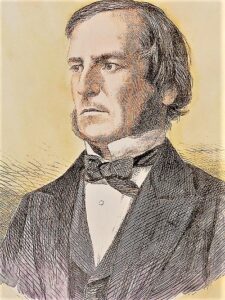
Quick Facts Of George Boole
- Born: 2 November 1815, Lincoln, United Kingdom
- Famous For: English mathematician, and a founder of the algebraic tradition in logic
- Nationality: British
- Education: Bainbridge’s Commercial Academy
- Spouse: Mary Everest Boole (m. 1855–1864)
- Children: Ethel Lilian Voynich, Alicia Boole Stott, Lucy Everest Boole, Mary Ellen Boole Hinton, Margaret Taylor
- Region: Western philosophy
- Died: 8 December 1864, Ballintemple, Cork, Ireland
- Cause of Death: Pneumonia
- Burial: St Michael’s Church
- Awards: Royal Medal
Early Life Of George Boole
George Boole was born in Lincoln on November 2, 1815. He is the eldest son of John Boole and Mary Ann Joyce; very soon after, his sister Mary Ann was born, followed by William and Charles. John Boole is a shoemaker, his wife a chambermaid, he is passionate about science, literature, and mathematics.
In his store window, he proudly and enthusiastically displays a telescope he built. John Boole passed on to his son George “the love of study and books” and his passion for optics and astronomy, and they both made kaleidoscopes., sundials, and even trying to build a rudimentary calculating machine.
The income of the spouses barely allows enough to meet the needs of the family. George, therefore, studied in the local school and, in order to move up the social ladder, he studied Latin and Greek, while the bookseller William Brooke helped him in his study of Latin and also taught him the basics of grammar.
At the age of fourteen, he translated from Greek a poem Meleager, “Ode to Spring“, published in the Lincoln Herald, the local newspaper. His age is noted in the article, a teacher wrote the newspaper, not believing that a young boy is capable of such a translation.
This first controversy and the criticisms leveled at its translation prompted him to intensify his efforts to master ancient languages. After primary school, the only secondary education that a father can offer his eldest son is to follow, from September 10, 1828, courses taught at Thomas Bainbridge’s Commercial Academy in the City of Lincoln.
George made remarkable progress in mathematics there and concentrated especially on the study of algebraic equations. During his free time, he learns French, German, and Italian on his own, languages that will be useful for him to understand and develop his own mathematical ideas. Unfortunately, John Boole neglects his shoe repair business, which leads to bankruptcy.
George Boole Education
George Boole did not study for an academic degree, however, from the age of 16, he was an associate teacher at Heigham’s School in Doncaster. This was somewhat constrained on him since his dad’s business fell and he ended up supporting financially his parents, and siblings.
Mathematical Logic
George Boole was probably the first mathematician after John Wallis to turn to logical problems. The idea of applying the symbolic method to logic was first expressed by him in his article “Mathematical Analysis of Logic” (1847).
Dissatisfied with the results obtained in it, Boole expressed the desire that his views be judged on the basis of the extensive treatise “Investigation of the laws of thought, on which mathematical theories of logic and probability are based
