
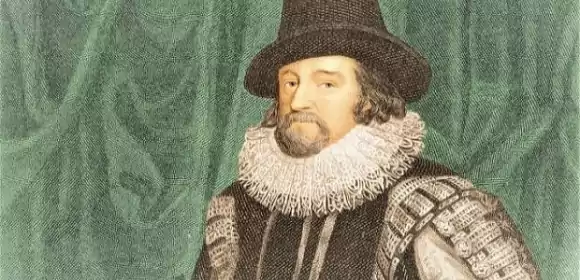
Francis Bacon (Born on 22 January 1561 – Died on 9 April 1626), also known as Lord Verulam, was an English philosopher, politician, lawyer, and essayist. Bacon was served as Attorney General and as Lord Chancellor under the reign of Elizabeth I Tudor and James I Stuart.
Although disgraced politically in 1621, he nevertheless remained extremely influential through his works, especially as a philosophical lawyer and practitioner of the scientific method during the scientific revolution.
Francis Bacon has been called the father of empiricism. His works established and popularized inductive methods of scientific inquiry often referred to as the Baconian method, or simply the scientific method.
His demand for a planned procedure of examining all things marked a new turn in the rhetorical and theoretical framework of science, much of which encompasses notions of correct methodology to this day. His dedication likely led to his death. This puts him in a rare historical group of scientists who were killed by their own experiments.
Bacon was knighted in 1603, receiving the title of Earl of Verulam in 1618, and Viscount of St Albans in 1621; because he died without heirs, both peerages died out after his death. He is known to have died of pneumonia while studying the effects of freezing meat on shelf life.
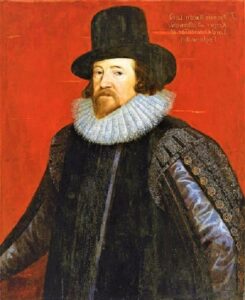
Quick Facts Of Francis Bacon
- Born: 22 January 1561, The Strand, London, England
- Also Known as: Lord Verulam, 1st Viscount St Alban
- Known For: Scientific Method
- Education: Trinity College, Cambridge (no degree), Gray’s Inn (call to the bar, 1582)
- Spouse: Alice Barnham (m. 1606–1626)
- Father: Sir. Nicholas Bacon
- Mother: Lady Anne Bacon
- Died: 9 April 1626 (aged 65), Highgate, Middlesex, England
- Buried: St. Michael’s Church, St. Albans
- Quotes: Some books are to be tasted, others to be swallowed, and some few to be chewed and digested.
Early Life Of Francis Bacon
Francis Bacon was born on January 22, 1561, at York House near the Strand in London. Bacon was the youngest son of Sir. Nicholas Bacon, Guardian of the Royal Seal by Queen Elizabeth I, and his second wife Anne Cooke Bacon.
Bacon was sent to the Trinity College of Cambridge University with his brother Anthony Bacon at the age of 12. He stood out from his childhood by the precocity of his genius and early conceived the design of reforming the sciences, but he was for a long time diverted from this project by the care of his fortune.
In his youth, he accompanied the British Ambassador Amias Paulet in France to the court of Henry III. Recalled to his country by the death of his father, he was admitted to a lawyer, and successfully engaged in the study of jurisprudence (the theory or philosophy of law).
However, preferring a career in public affairs, he became attached to the Earl of Essex and became a member of the House of Commons (1592). Although he had consented, in order to win the favor of Queen Elizabeth, to justify the condemnation of the unfortunate Essex, her protector, he only received from her the honorary title of Queen’s Counsel.
He also studied for a time at the University of Poitiers.
Political Career
In 1584, Francis Bacon was elected to the House of Commons, as a representative of a small district. At that time he wrote the Letter of Advice to Queen Elizabeth I, who advocated various measures of religious tolerance and state supremacy in relation to the Church.
Intending to connect with the crown services, he made use of the influences of the royal treasurer Lord Burghley, his maternal uncle, and the Earl of Essex until he became his private adviser. But he was unable, under Elizabeth I, to be appointed attorney general, as he hoped.
Under the reign of James I, he was successively appointed Attorney General (1607), Inspector General (1613), Lord Counselor (1616), Lord Guardian (1617), and finally Lord Chancellor (1618). Still, in 1618 he was named Baron Verulam and, in 1621, 1st Viscount of St. Albans.
In 1621, Francis Bacon, the King’s Grand Chancellor, was accused of bribery and corruption by the House of Commons and sentenced by the House of Lords to pay a huge fine and imprisonment in the Tower of London.
Although forgiven by the king, he can no longer return to public activities, however, he had gained a reputation as a speaker and writer. The rest of his life was devoted entirely to scientific philosophy and political essays. And his literary work was much more important than his entire career as a statesman.